Can I Get a Senior Management Job by 40? Unlikely, but Let's Speculate
Up until that moment, I had a clear vision of my career track. After graduation, I became an L1 Support Engineer, dreaming of landing a product management role. That gap was too large to cover, so the role of a business analyst seemed like a reasonable intermediate step.
I also had a precise timeline: transition from support to business analysis by 24, then become a PM by my thirties. That plan worked out, even though the path itself was neither always obvious nor easy.
Now, I am near 35 and a senior product manager. Dream came true. The problem is, I don't know which career goal to target next. Or if I need to target anything at all.
And yes, here I will talk about how PM roles have changed due to AI and the broader economic shakeup. But in the context of my own career plans. Sounds egoistic? Yes, it is. But allow me some thought experiments. Maybe that will be helpful for you.
The Plan That Worked — Until It Didn't
The context of the PM role greatly varies, so I need to answer a critical question first:

My short response: "I am a Platform/Technical Product Manager."
A longer response:
"I am a Platform/Technical Product Manager. But I am not as technical as my peers with an engineering background. And for more traditional PMs — the ones with A/B tests, PRDs, AARs, and many other fancy buzzwords — I am that nerdy guy who builds platforms for building platforms."
Not a comprehensive answer, but I need to start from somewhere. So, what are my next career development options?
Before we proceed, let's address the elephant in the room. To further my career, I need to navigate the now-traditional waves of layoffs.
Here is AI reshaping the PM role, and corporations that discovered mass layoffs increase capitalization. I'll leave speculation on how those factors interdepend — let's focus on the AI aspect.
From my perspective, Tech PMs in enterprises in heavy B2B industries like finance and insurance are feeling better than their B2C colleagues. It does not mean they are not impacted or will not be affected in the near future. However, deeper specialization in complex, legally liable industries at least delays execution.
But I would say, surviving layoffs is mostly a matter of luck.
Let's assume I am a lucky one — so what are the options to push my career forward?
Corporate Ladder (Gone)
Junior positions are extinct. There is no fresh blood to push the career system forward. I wrote a piece about the exodus of junior business analyst positions almost a year ago.
Middle management is severely cut, leaving a handful of ICs (individual contributors) with so-called "leadership." That means there is no longer space to manoeuvre horizontally. The door to the top is not widely open either.
Senior management seems less affected. Of course, there are some sacrifices in the name of optimization. But those folks won't hurt themselves, will they?
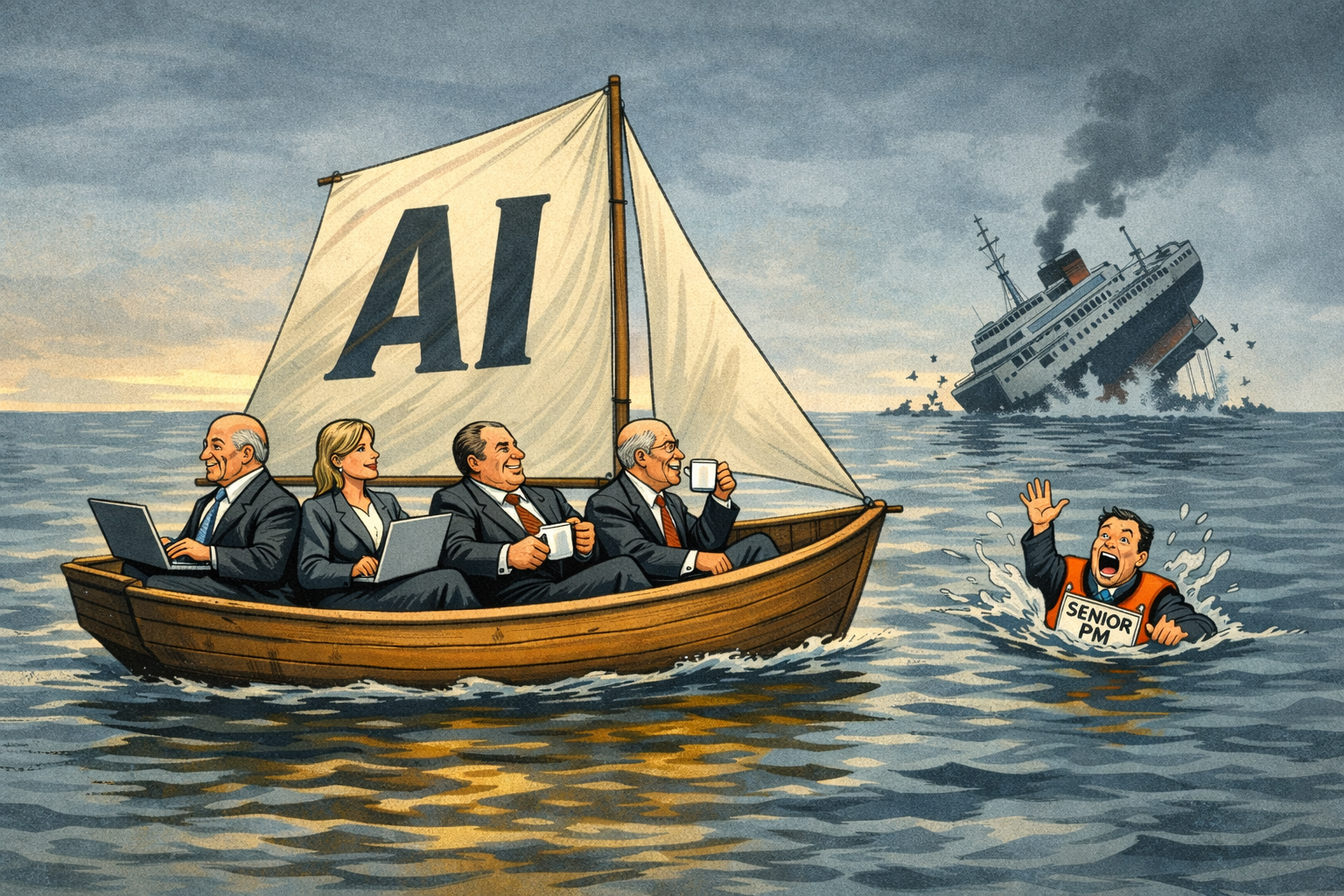
There is not much space at the top. As the economic situation is shaky, some of them won't take the risk to hop for another senior management position elsewhere or go rogue with their own startup. Those who are competent enough will stay where they are — even though a decade ago the preferable option might have been to retire and free a position for someone younger.
Here is a thought experiment of what the career trap in the middle looks like. It might be a case for me. It might be a case for you. All coincidences with real people are just coincidences.
Let's take switching to another business domain within the organization as an example:
You are a highly effective IC leader A in your domain, with deep expertise. You'd like to explore another domain within your organization — maybe you're bored, or you see some prospects elsewhere.
In that domain, there is another super-efficient IC leader B with deeper expertise than yours. You can't join as their subordinate, because those positions were "restructured" away and super-efficient B absorbed the responsibilities. IC leader A, as a reasonable person, would not undermine their own position. They also understand that combining both domains leads to burnout and is unlikely to be compensated.
And if the transition were to happen, IC leader B would have no opportunity to take a more senior position — they already report to a VP, since all middle layers were cut. So IC leader A is stuck, only hoping that something unexpected happens and IC leader B leaves on their own. And even if B leaves, A needs to prove they have enough experience to take B's place while also handing over their own domain to a new IC leader C.
Otherwise, IC leader A becomes ultra-efficient by absorbing everything.
Anyway, the overall idea is that planned internal growth is now difficult — unless you need to cover gaps caused by, well, you know what.
What's That for Me?
Thinking about my career, I asked myself: can I become a senior manager figure and jump into that safe boat by 40?
Very unlikely. Without internal promotion, there is, of course, the option to look outside. But we all know what the job market looks like right now.
I could claim to become the same super-efficient (and AI-proficient) IC leader A in a different place — only if I get lucky, not spending 6 months on interviews and settling for a lower offer out of desperation. Any movement to claim another domain with little or no experience, or to jump to a top senior management job, would not yield much. There are plenty of strong candidates on the market with relevant experience. Some of them are desperate, and that's why they're dumping salaries. If you are not desperate, you basically can't compete.
I also thought that getting an MBA would be a prerequisite for a future senior management job — a way to become more visible to my current employer and bid higher in the job market. Obviously, it is no longer as big an advantage as it might have been before. Not counting the trash MBA courses, which were never relevant.
Any course from the top 50 MBA programs costs a significant amount of money. I decided to put those funds toward a mortgage down payment.
It was once said that gaining an MBA is a better investment than real estate. With AI, the current job market state, and rising property prices, I don't think that is the case anymore. As with most of the other tools our predecessors used to advance their traditional careers.
So What Now?
Do I have any chance of significantly advancing in my career anytime soon? Actually, yes. There are a few options beyond the good-old climb on the enterprise career ladder.
Maybe I will write another article on that.
Meanwhile, I continue to deepen my expertise and become a more super AI-efficient senior IC. To care less about job prospects in my 40s, I started a new hobby of painting Warhammer 40K miniatures.

Take care.
Get new essays by email
One or two a month. Nothing else.